


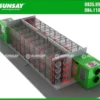


Industrial Rotary Drum Dryer Design – SUNSAY
Original price was: 1,200 $.1,000 $Current price is: 1,000 $.
Rotary Drum Dryer Design with a continuous indirect drying method, allowing for a short heat retention time while evaporating all liquid in a single rotation of the drum. It not only helps minimize the risk of product damage but also preserves the product’s unique characteristics such as taste, aroma, and
Rotary Drum Dryer Design with a continuous indirect drying method, allowing for a short heat retention time while evaporating all liquid in a single rotation of the drum. It not only helps minimize the risk of product damage but also preserves the product’s unique characteristics such as taste, aroma, and texture.

MỤC LỤC
What is a rotary drum dryer machine?
Drum dryer, developed in the early 1900s, is now used in both the food and chemical industries to dry heavy pastes, sludge, finely ground materials, and viscous liquids, as well as in the production of powders and dehydrated flakes.
Dried products include pre-cooked or concentrated starch, baby food, dairy products, mashed potatoes, caseinates, fruit and vegetable powders, dry soup mixes, maltodextrins, yeast cream, pre-cooked breakfast cereals, spent yeast, polyacrylamide, sodium benzoate, proteins, and acetates.
In general, drum dryers are used to obtain dried products that are porous and easily rehydrated, ready for use in beverages, bakery products, cereals, dairy applications, and chemical processes. This drying method is suitable for viscous products, either in their natural state or after concentration, and they must be dried in the form of a very thin film.

Technical specifications
| Weight | 5500 kg |
|---|---|
| Height | 20000 × 5000 × 4500 cm |
Features of rotary drum dryer
- High thermal efficiency
- Maximum stability and long, continuous service life
- Designed to meet the highest hygiene standards
- Various configurations available to meet different application requirements
- Vacuum drying for heat-sensitive product components
Design principle of a rotary drum dryer machine
The drum body of the dryer is internally heated by steam. The special composition of cast iron provides the dryer with a combination of advantageous properties: maintaining precise shape even under high steam pressure and temperature, and offering excellent “scraping properties” for the doctor blade.
Steam heating ensures uniform temperature distribution across the drum surface, resulting in consistent product quality. Steam condenses inside the drum, and the condensate is continuously removed, allowing the maximum internal surface area of the drum to remain available for steam condensation.
The steam system is a closed system, meaning the product does not come into contact with steam or condensate.
Depending on the drum dryer design, the product is continuously applied as a thin film on either the lower or upper surface of the main drum. As the drum rotates and is heated internally, the product dries on the outer surface of the drum.
The short exposure time to high temperatures reduces the risk of product damage. Water or solvent evaporates and exits the process at the outlet. If necessary, vapor can also be locally extracted around the drum. The dried product film finally reaches the blade and is scraped off.
In double drum dryers, the product is fed into a reservoir between two main drums (which always rotate in opposite directions). The small gap between the drums can be precisely adjusted to obtain the desired film thickness.

Advantages of rotary drum dryer design
- The products have good porosity and therefore excellent rehydration capacity due to the evaporation of boiling water.
- Drum dryers can handle highly viscous foods, such as pastes and gelatinized or cooked starches, which are difficult to dry using other methods.
- Drum dryers generally have high energy efficiency.
- The drying drums can be kept clean and hygienic.
- Drum dryers are easy to operate and maintain.
- They are flexible and suitable for large-scale production as well as small batch quantities.
Furthermore, the main advantages of drum drying include high drying rates and economical heat utilization. However, the disadvantages of drum drying are as follows:
- Some products do not form a good film on the drum surface and are not suitable for drum drying.
- Certain products, especially those with high sugar content, may not be easily scraped off the drum.
- It has relatively lower throughput compared to spray drying.
- Due to precision manufacturing requirements, drum replacement costs are high.
- Products may become scorched, leading to a cooked flavor and color loss due to direct contact with the high-temperature drum surface.
- It is not suitable for processing saline or corrosive materials, as the drum surface may become pitted.

Selection of professional rotary drum dryer technology
Sometimes, poor quality in the final product may be related to disturbances during the drying process, such as fluctuations in the initial moisture content and thickness of the product, or the accumulation of non-condensable gases inside the drum, which causes localized poor heat transfer.
Therefore, selecting the appropriate drum dryer is very important. The most common types include single drum dryers and double drum dryers. A single drum dryer consists of a hollow metal cylinder mounted on a horizontal shaft and mechanically rotated with variable speed control.
The drum is heated by steam, hot water, or other heating media that condense on its inner surface. The drying effect is achieved by heat transfer from inside the drum, through its metal wall, to a thin film of material spread over the outer surface.
Key factors to consider when using a single drum dryer include uniform film thickness on the drum surface, rotation speed, and heating temperature. All these factors affect the drying rate, and therefore, various types of drum dryers have been developed.

A double drum dryer consists of two cylinders (drums) of equal diameter rotating very close to each other in opposite directions. The material to be dried is fed into the wedge-shaped gap between the drums through a distribution pipe.
Heat is transferred from the hot drum surface to the wet material. The rotation of the cylinders causes the material in the feed zone to pass through the narrow gap between them, forming two thin films. After drying, these films are removed as thin sheets by doctor blades extending across the full width of the drums.
The most important factors affecting the performance of a double drum dryer include steam pressure, drum rotational speed, the degree of adhesion between the material and the drums, the gap between the drums, and the condition of the feed material, including concentration, physical properties, and the temperature at which the material reaches the drum surface.
Furthermore, double drum dryers can handle a wider range of products and generally provide better economy, higher efficiency, greater production capacity, and require less operating labor compared to other equipment.
Finally, there is also a twin-drum dryer configuration in which the two drums are spaced apart at the top. Single drum and double drum dryers are mainly used for drying fruits and vegetables, while double drum dryers are particularly suitable for drying materials such as inorganic salt solutions (crystalline or crystal-forming) and materials that generate dust, such as cosmetic powders.
Type of Food Dryer


Images of some rotary drum dryer design projects.

Rotary drum dryer design Services
SUNSAY Dryer specializes in providing rotary drum dryer design services for manufacturing plants both domestically and internationally.
For detailed consultation, please visit our website: kynghexanh.com.vn or contact our Hotline (Zalo): 0935 940 886 or call our switchboard: 094 110 8888 for assistance.
Thank you for your interest in SUNSAY’s rotary drum drying design services.
Be the first to review “Industrial Rotary Drum Dryer Design – SUNSAY”
Related products
Reviews
There are no reviews yet.